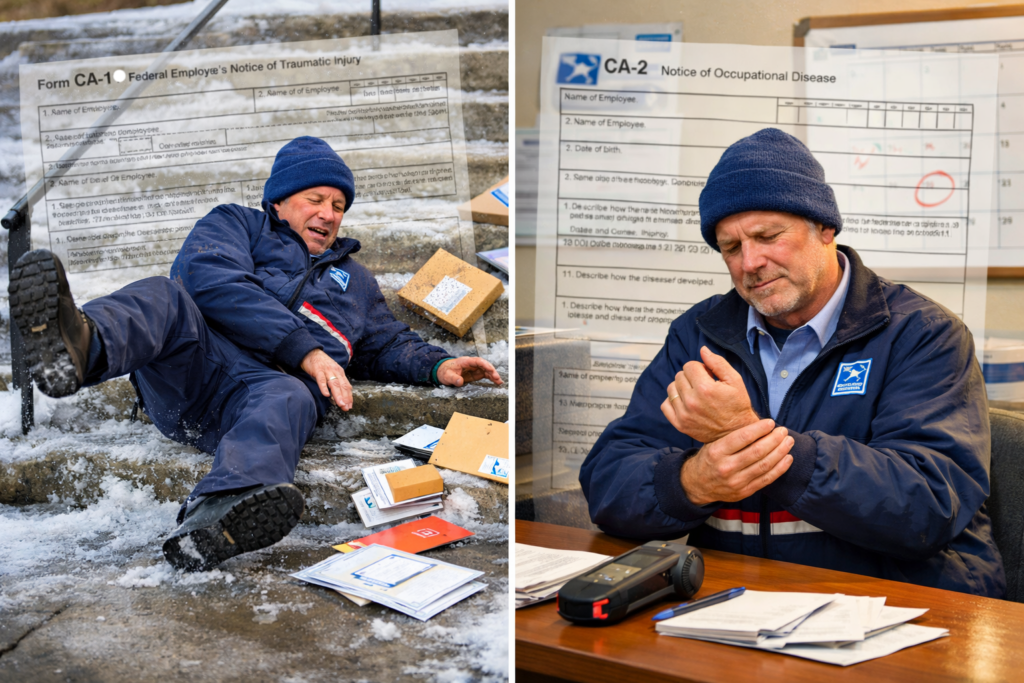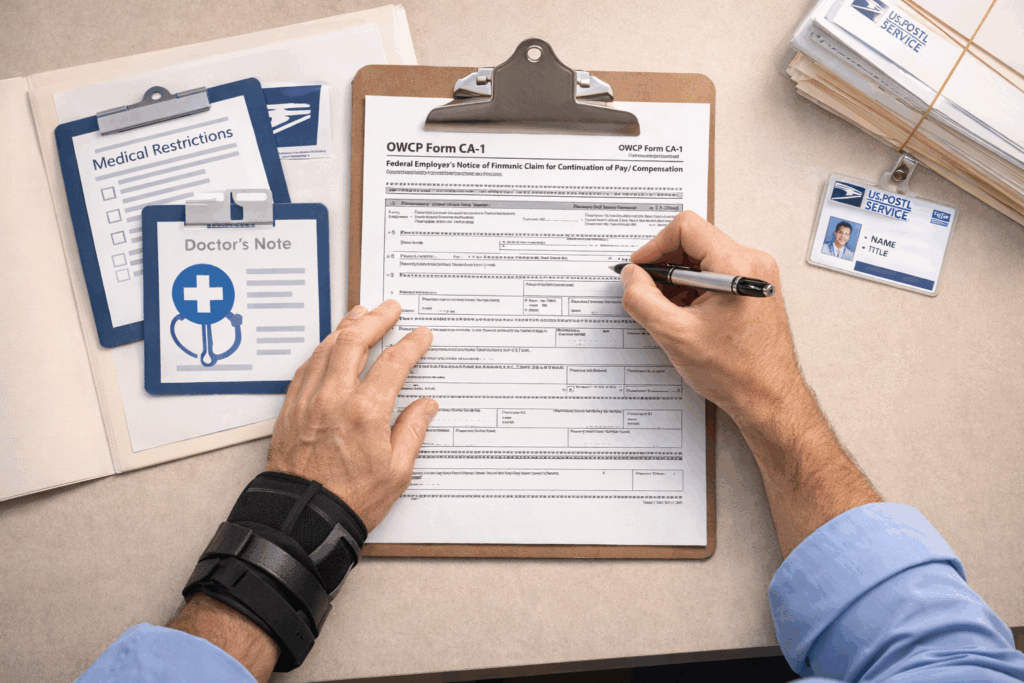
If a medical condition is making it impossible to keep up with the demands of your postal job, FERS disability retirement may be an option worth understanding. It’s a federal program that allows eligible USPS employees to retire early on the basis of a disabling condition — not age or years of service.
This guide walks you through the entire process in plain language — who qualifies, what forms to file, how long it takes, and what your income looks like on the other side.
What Is FERS Disability Retirement?
The Federal Employees Retirement System (FERS) includes a disability retirement benefit for federal workers who can no longer perform the essential duties of their position due to a medical condition.
This is separate from workers’ compensation. It is not limited to on-the-job injuries. A qualifying condition can be physical or mental — anything that permanently prevents you from doing your current job.
FERS disability retirement is administered by the U.S. Office of Personnel Management (OPM), not the Postal Service or OWCP.
Who Qualifies for FERS Disability Retirement?
To be eligible, you must meet all of the following conditions:
- You are a FERS-covered employee (most USPS workers hired after 1983 are covered)
- You have completed at least 18 months of creditable federal civilian service
- You have a medical condition that is expected to last at least one year
- Your condition prevents you from performing the essential functions of your current position
- The Postal Service cannot accommodate your limitations or reassign you to a comparable position
You do not need to be close to regular retirement age. You do not need a work-related injury. The condition simply needs to be documented and serious enough to make your current role unsustainable.
Step 1: Talk to Your Doctor First
Before filing anything, have an honest conversation with your treating physician. Your medical documentation is the foundation of your entire application.
Your doctor will need to:
- Provide a detailed description of your diagnosis
- Explain how the condition affects your ability to perform specific job duties
- Confirm the condition is expected to be long-term or permanent
- Complete the Physician’s Statement included in the OPM application package
Weak or vague medical documentation is one of the most common reasons FERS disability retirement applications are denied. The more specific the documentation, the stronger your application.
Step 2: Notify Your Employer and Request Accommodation
Before OPM will approve a disability retirement application, the Postal Service must confirm that it was unable to accommodate your medical limitations or offer a reassignment to another position at the same grade and pay.
You should formally notify your supervisor or HR department of your medical condition and limitations. This triggers the accommodation review process.
Keep written records of all communications. If the USPS is unable to accommodate you, they will document that as part of the application package.
Step 3: Gather Your Application Documents
The main application form is SF-3107, Application for Immediate Retirement, along with SF-3112, Documentation in Support of Disability Retirement.
The SF-3112 package includes several parts:
- SF-3112A: Applicant’s Statement of Disability — your personal account of how your condition affects your ability to work
- SF-3112B: Supervisor’s Statement — completed by your postal supervisor describing your job duties and how your condition limits your performance
- SF-3112C: Physician’s Statement — completed by your treating doctor
- SF-3112D: Agency Certification of Reassignment and Accommodation Efforts — completed by the Postal Service
You will also need to provide medical records, treatment history, and any relevant test results.
Step 4: File Before Separation or Within One Year After
You can file your FERS disability retirement application while still employed, or within one year of being separated from federal service. Filing while still on the rolls is generally recommended — it keeps your options open and gives you more time to build a complete application.
Before or during the filing period, many employees exhaust their available leave. Understanding how USPS sick leave works and what you’re entitled to is worth reviewing before you reach that point, so you’re not caught off guard.
Step 5: Your Agency Submits the Application to OPM
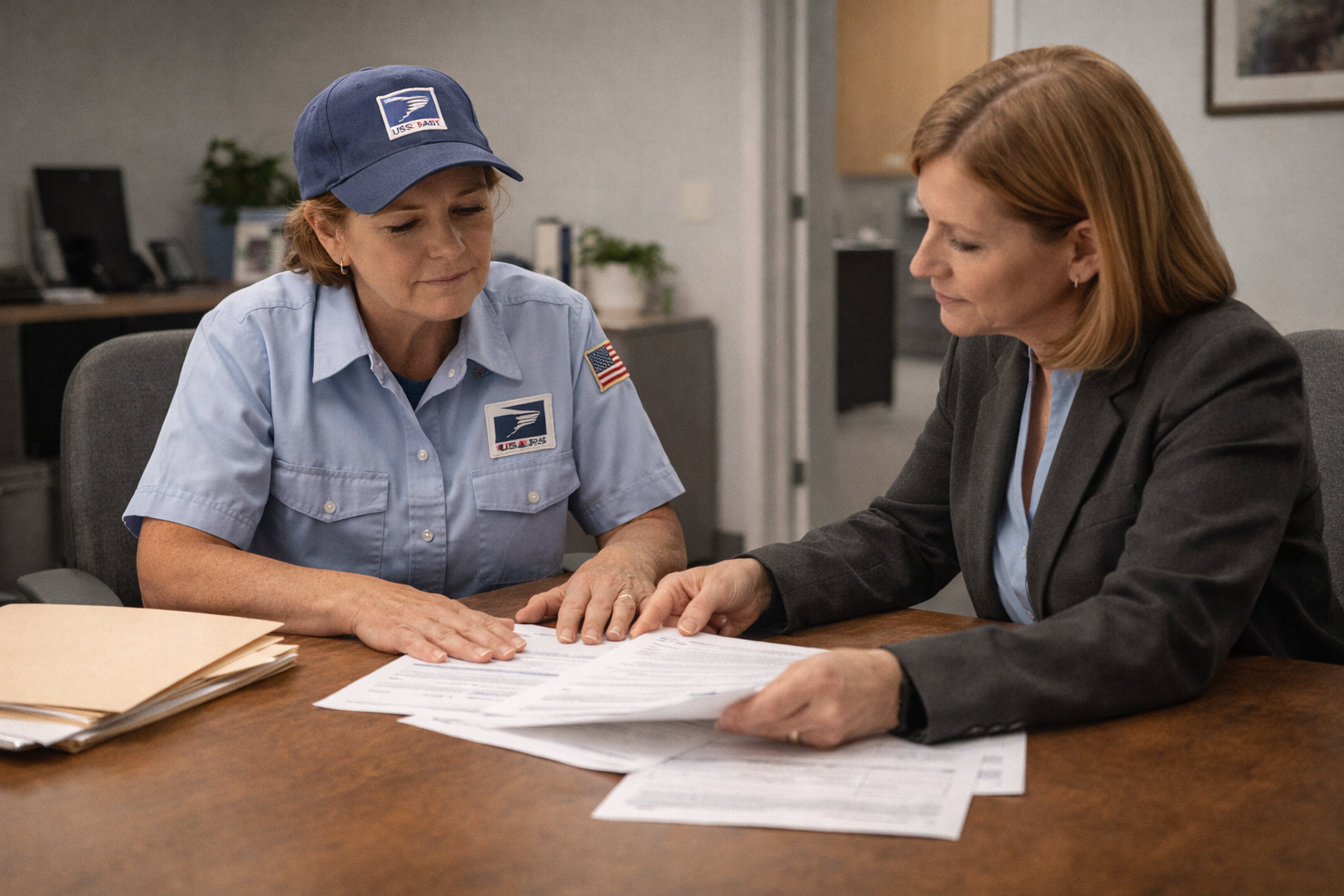
Once all parts of the application package are complete, the Postal Service’s HR shared services team compiles and submits everything to OPM on your behalf. You cannot submit directly to OPM yourself — it must go through your agency.
This is another reason staying in close contact with your HR department throughout the process matters.
Step 6: OPM Reviews and Issues a Decision
OPM will review your application and may request additional medical documentation or clarification. Review timelines vary, but initial decisions can take several months.
If approved, OPM will notify you in writing and begin processing your annuity.
If denied, you have the right to request reconsideration within 30 days of the denial notice. If reconsideration is also denied, you can appeal to the Merit Systems Protection Board (MSPB).
What Happens While You Wait
The period between filing and receiving a decision can involve significant income uncertainty. Many employees enter Leave Without Pay (LWOP) status during this time, particularly once their sick and annual leave balances run out.
LWOP affects your pay, your federal benefits, and your retirement calculations. If you’re heading into an extended LWOP period while waiting on an OPM decision, it helps to understand exactly how that status works — this breakdown of USPS LWOP rules and how they affect your benefits covers the key details.
What Does FERS Disability Retirement Pay?
FERS disability retirement benefits are calculated differently than regular retirement.
For the first 12 months after approval:
- You receive 60% of your high-3 average salary, minus 100% of any Social Security disability benefit you receive
After the first 12 months:
- The benefit drops to 40% of your high-3 average salary, minus 60% of any Social Security disability benefit
Once you reach age 62, OPM recalculates your benefit using the standard FERS retirement formula based on your years of service.
These figures are estimates. Your actual benefit depends on your specific salary history, Social Security eligibility, and other factors.
Social Security Disability and FERS — Do You Have to Apply?
Yes. OPM requires FERS disability retirement applicants to also apply for Social Security Disability Insurance (SSDI) benefits. If Social Security approves your application, OPM will offset your FERS benefit accordingly during the first year.
If Social Security denies your SSDI application, your FERS benefit is not penalized — but OPM still requires proof that you applied.
For more information on SSDI eligibility and how it interacts with federal retirement programs, the Social Security Administration provides guidance at ssa.gov.
Health and Life Insurance During FERS Disability Retirement
One of the significant advantages of FERS disability retirement over simply resigning is that you can maintain your federal health and life insurance coverage in retirement — provided you were enrolled in those programs for at least five years before your retirement date.
Federal Employees Health Benefits (FEHB) and Federal Employees’ Group Life Insurance (FEGLI) coverage can continue into retirement under those conditions, which represents meaningful long-term value.
What FERS Disability Retirement Does Not Cover
It is important to be clear about the income replacement rate. FERS disability retirement replaces a portion of your salary — not all of it. Even in the first year at the 60% rate, there is a gap between what you were earning and what you will receive.
That income gap is where private disability insurance can provide meaningful support during the transition period and beyond. FERS retirement is a foundation, not a complete replacement.
Putting It Together
FERS disability retirement is a structured, documented process that takes time and attention to detail. The stronger your medical evidence, the more complete your paperwork, and the better your communication with HR — the smoother the process tends to go.
It is not a fast solution, but for USPS employees dealing with long-term or permanent medical conditions, it provides a path to stable federal benefits after your working years come to an end.
If you’re a USPS employee navigating a medical condition and wondering how your disability income protection options fit alongside FERS, Postal Life and Disability Plans can help you understand the full picture. There’s no obligation — just clear information to help you make informed decisions about your financial security. Visit postallifeanddisabilityplans.com to learn more.