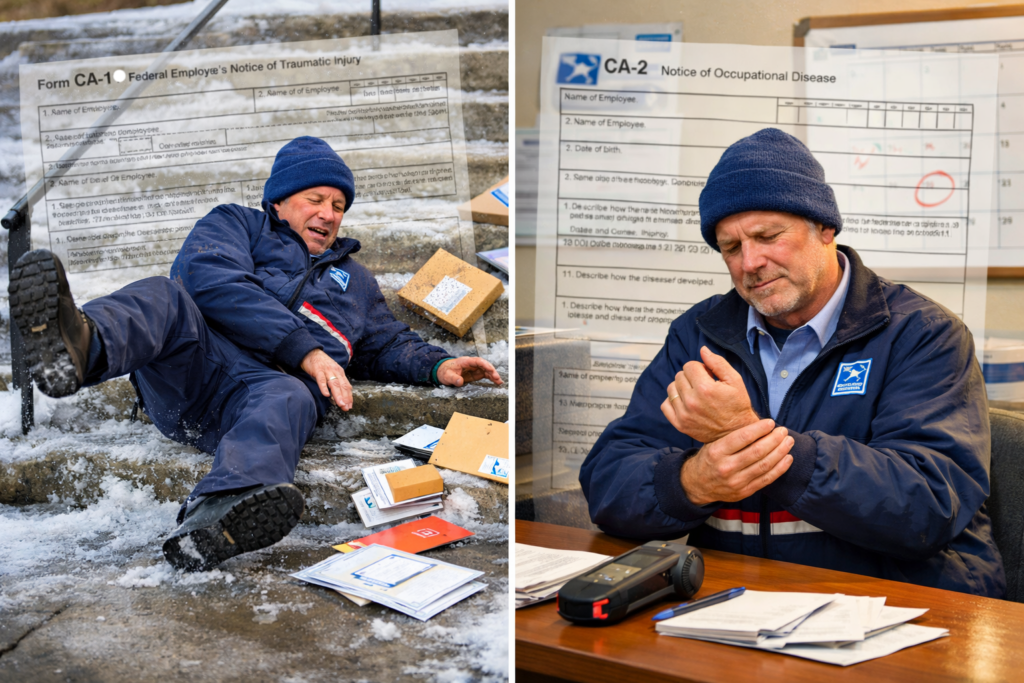
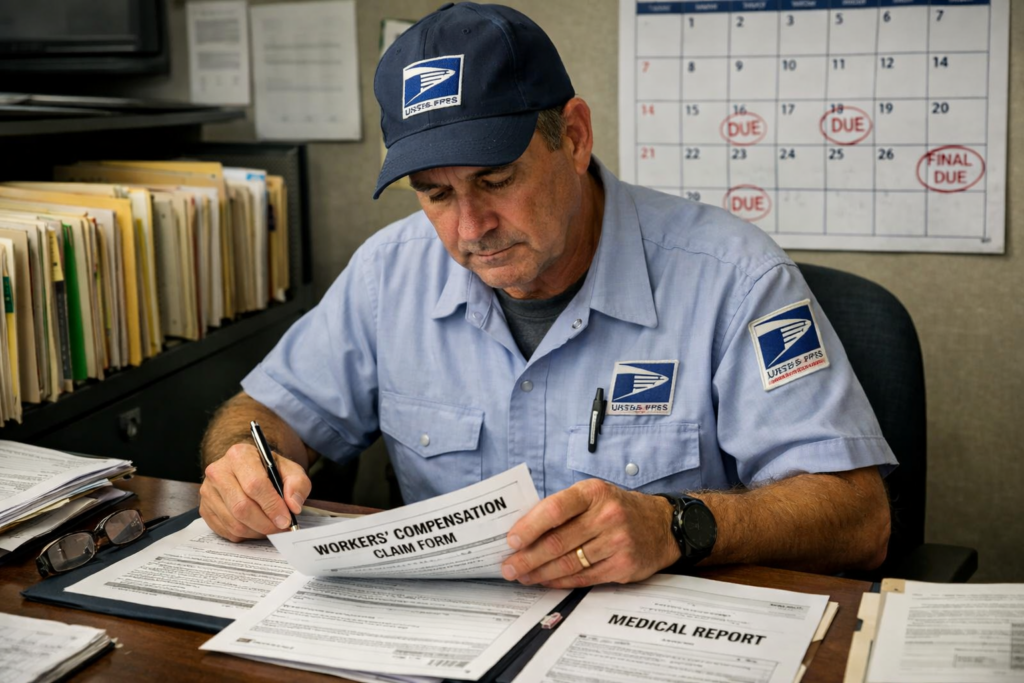
When a USPS employee is injured or becomes ill, income protection quickly becomes a top concern. You may be dealing with medical appointments, work restrictions, and uncertainty about when—or if—you can return to full duties. At the same time, you’re expected to navigate a federal claims process that can feel unfamiliar and stressful.
The Office of Workers’ Compensation Programs (OWCP) exists to provide wage-loss and medical benefits for eligible federal employees, including those at the U.S. Postal Service. Yet many OWCP claims are delayed or denied due to preventable errors. Understanding how the process works—and where claims commonly go wrong—can help you reduce setbacks and protect your income during recovery.
This article explains the most common OWCP claim mistakes, step by step, and outlines practical ways to avoid them.
Understanding OWCP and why claims are denied
OWCP is part of the U.S. Department of Labor. It administers workers’ compensation benefits for federal employees who experience job-related injuries or occupational illnesses.
OWCP does not deny claims arbitrarily. Denials usually occur because required information is missing, timelines are not met, or the evidence does not clearly support that the condition is work-related. In many cases, the issue is procedural rather than medical.
Understanding the structure of the process helps explain why accuracy and documentation matter so much.
Key OWCP terms to know
Before reviewing common mistakes, it helps to understand a few acronyms that appear throughout the claims process:
- OWCP (Office of Workers’ Compensation Programs): The agency that reviews and administers federal workers’ compensation claims.
- COP (Continuation of Pay): Up to 45 calendar days of pay for eligible traumatic injuries, paid by USPS.
- CA-1: The form used for traumatic injuries with a specific date and time.
- CA-2: The form used for occupational diseases or conditions that develop over time.
- LWOP (Leave Without Pay): A non-pay status that may apply when COP or paid leave is unavailable or exhausted.
Each of these plays a role in how income replacement is handled during a claim.
Mistake 1: Using the wrong injury form
One of the most common reasons OWCP claims are denied or delayed is filing the incorrect form.
CA-1 vs. CA-2: why the distinction matters
- CA-1 (Traumatic Injury): Used when an injury occurs during a single work shift or specific event, such as a slip, fall, or lifting incident.
- CA-2 (Occupational Disease): Used when a condition develops over time due to repetitive activity or prolonged exposure, such as repetitive strain injuries.
Submitting a CA-1 for a condition that developed gradually—or a CA-2 for a single-event injury—can lead to confusion, additional requests for information, or outright denial.
How to avoid this mistake
Before filing, clearly identify whether your condition resulted from a single incident or developed over time. If you are unsure, reviewing USPS injury reporting guidance or consulting your supervisor can help clarify which form applies.
Mistake 2: Missing filing deadlines
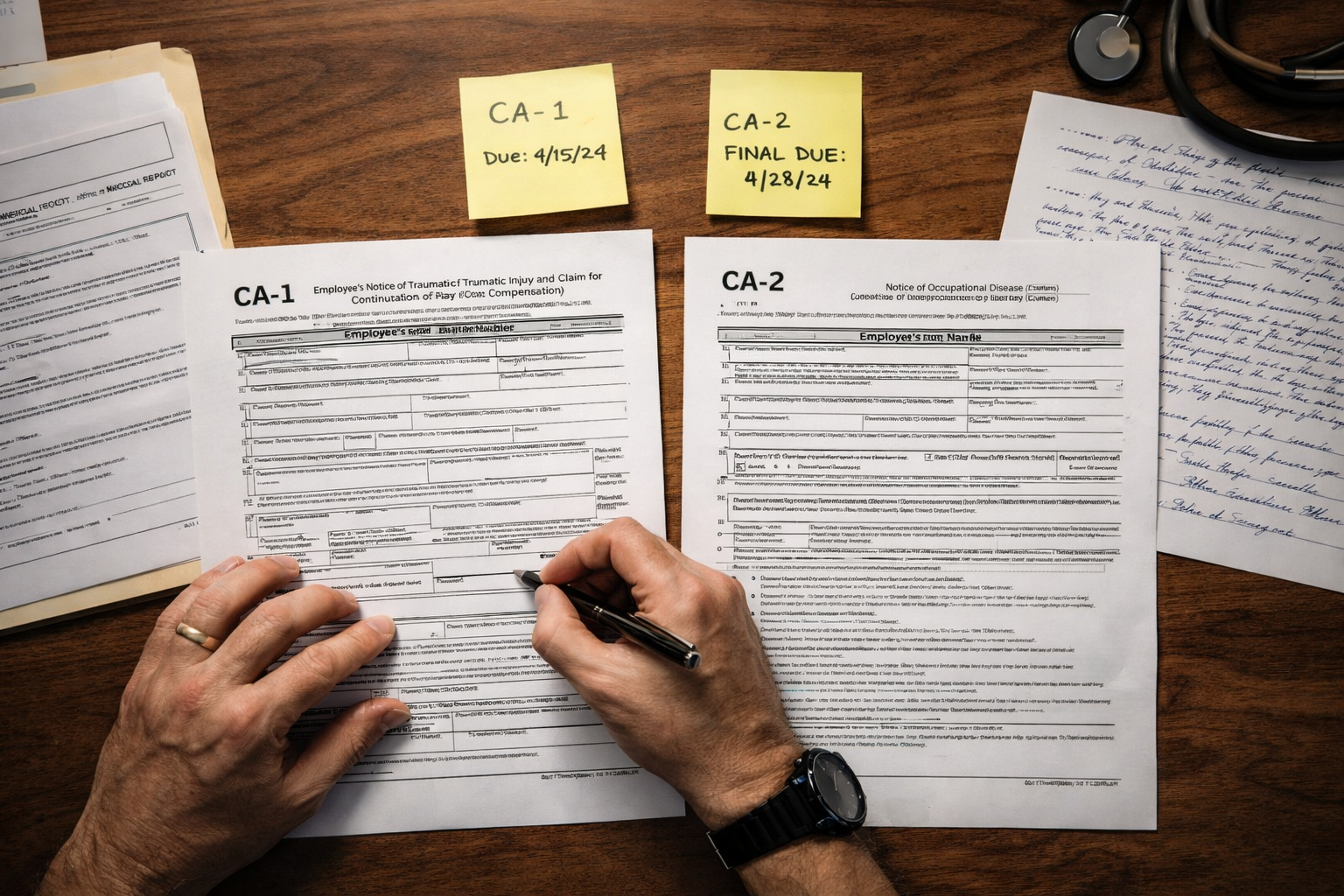
OWCP claims are time-sensitive. Even valid injuries can be denied if forms are not submitted within required timeframes.
Common deadline issues
- Delayed injury reporting: Waiting weeks or months to report an injury raises questions about work-relatedness.
- Late form submission: Filing CA-1 or CA-2 forms outside recommended timeframes can slow or jeopardize the claim.
- Missed follow-up requests: OWCP often sends development letters requesting additional information by a specific date.
How to avoid this mistake
Report injuries as soon as possible, even if symptoms seem minor at first. Respond promptly to any OWCP correspondence and keep copies of all submissions.
Mistake 3: Incomplete or vague medical documentation
Medical evidence is central to every OWCP decision. Many denials occur because medical reports do not meet OWCP’s requirements.
What OWCP expects from medical evidence
Medical documentation should clearly explain:
- The diagnosed condition
- How the condition is connected to work duties
- Any work restrictions or limitations
- Expected duration of disability or treatment
Statements such as “patient reports pain” without explanation of causation are often insufficient.
How to avoid this mistake
Ask your treating provider to clearly describe how your job duties contributed to the condition. Medical reports should be detailed, factual, and specific—not generic.
Mistake 4: Failing to explain the work connection
OWCP does not assume an injury is job-related simply because it occurred while you were employed. The burden is on the claimant to establish a clear connection between work duties and the medical condition.
Common issues with causal connection
- Job duties are listed but not linked to the condition
- The timeline between work exposure and symptoms is unclear
- Non-work factors are mentioned without explanation
How to avoid this mistake
When completing your CA-1 or CA-2, describe your job tasks in detail and explain how they relate to your injury or illness. Consistency between your form and medical documentation is essential.

Mistake 5: Not understanding Continuation of Pay (COP) rules
Many USPS employees assume COP applies to all work-related conditions. This misunderstanding can create income gaps.
Key COP limitations
- COP applies only to traumatic injuries filed under CA-1
- It is limited to 45 calendar days
- COP does not apply to occupational disease claims (CA-2)
If COP ends and OWCP compensation is not yet approved, employees may experience unpaid time or need to use leave.
How to avoid this mistake
Plan ahead for the possibility of income interruption. Understanding when COP ends—and what comes next—can reduce financial stress during recovery.
Mistake 6: Ignoring OWCP development letters
When OWCP needs clarification, it issues a development letter requesting additional evidence. These letters are time-sensitive and critical to claim approval.
Why development letters matter
Failure to respond by the deadline often results in denial due to insufficient evidence—even if the claim might otherwise be valid.
How to avoid this mistake
Open and review all OWCP correspondence immediately. Note deadlines, gather requested documents, and submit responses promptly.
Mistake 7: Assuming approval means full income replacement
Even approved OWCP claims do not necessarily replace 100% of lost wages. Compensation rates vary and are subject to eligibility rules.
Common misunderstandings
- Compensation percentages differ based on dependency status
- Payments may not begin immediately
- Partial disability may result in reduced benefits
How to avoid this mistake
Review OWCP compensation rules carefully and plan your finances with realistic expectations. Understanding potential shortfalls helps you prepare for recovery periods.
Step-by-step checklist to reduce denial risk
To help avoid common pitfalls, consider this simplified checklist:
- Report the injury or illness promptly
- Choose the correct form (CA-1 or CA-2)
- Complete all sections accurately and consistently
- Provide detailed medical documentation
- Respond quickly to OWCP requests
- Track deadlines and copies of all submissions
For official guidance on OWCP procedures and documentation standards, the U.S. Department of Labor provides detailed resources through its OWCP program pages.
Why preparation matters for USPS employees
An OWCP denial does not always mean a claim is invalid—but it often means delays, added stress, and uncertainty during an already difficult time. By understanding the most common mistakes and how to avoid them, USPS employees can navigate the claims process with greater confidence and fewer interruptions to income.
Disability-related income loss is rarely predictable. Being informed about OWCP requirements is one way to reduce financial uncertainty while focusing on recovery and health.
Protecting your income during recovery
OWCP benefits can play an important role in supporting USPS employees during injury or illness, but they are not automatic. Clear documentation, timely action, and understanding program limits are essential to avoiding claim denial.
If you’re dealing with injury-related income loss as a USPS employee, learning how disability income protection fits alongside OWCP benefits can help you better prepare for recovery. Reviewing your coverage options may provide additional clarity and financial stability during periods of work limitation.