
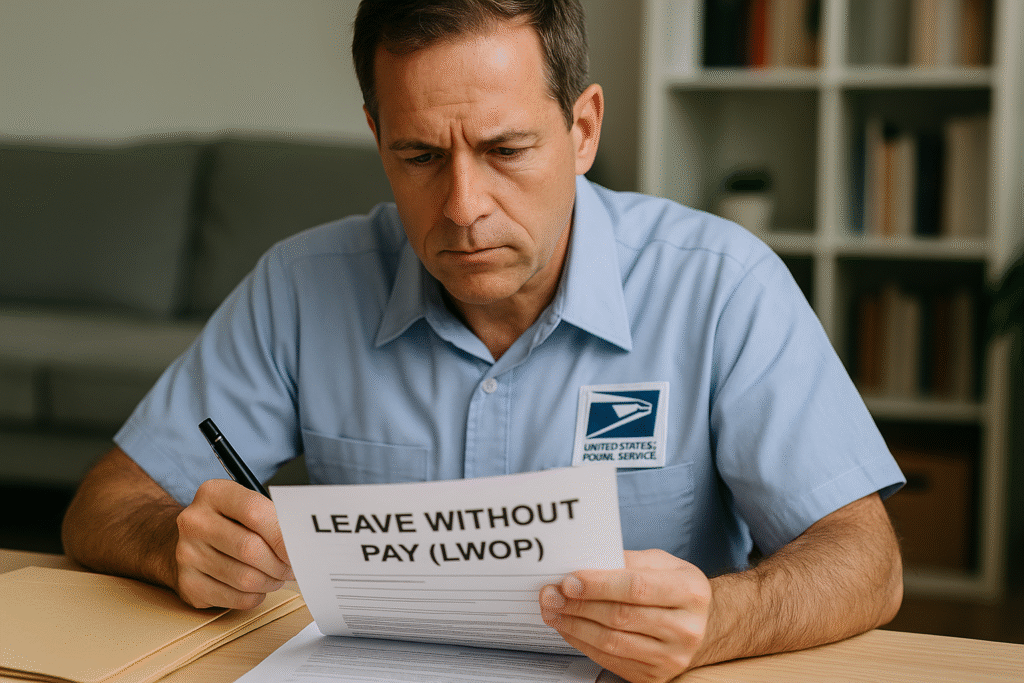
Leave Without Pay (LWOP) is a key part of the USPS leave system — but it’s also one of the most misunderstood. Whether you’re a city carrier, rural carrier, PSE, CCA, or a long-term USPS employee under FERS, understanding LWOP rules can protect your job, your benefits, and your income.
This guide breaks down exact USPS LWOP rules, how LWOP affects your retirement, TSP, attendance, health insurance, and when management is required to approve it.
What Is LWOP at USPS?
LWOP (Leave Without Pay) is an authorized absence from USPS in which you are away from work but do not receive pay. It is not a disciplinary status — it is a leave category.
Management may:
- Approve LWOP
- Disapprove LWOP
- Limit LWOP to certain hours
- Require documentation
LWOP is treated differently from sick leave, annual leave, FMLA leave, or paid administrative leave.
USPS LWOP Rules (Complete Breakdown)
1. LWOP Is Not Guaranteed — It Requires Management Approval
USPS policy states that LWOP is discretionary unless tied to:
- FMLA
- On-the-job injury (OWCP/CA-1 or CA-2)
- Military leave
- Certain MOU-protected situations
Management evaluates LWOP requests based on:
- Operational needs
- Employee attendance history
- Reason for absence
- Documentation provided
However, USPS also cannot arbitrarily deny LWOP in cases protected by law or MOU.
2. LWOP Counts as Employment, But Not as Paid Service
LWOP keeps you on the rolls as an active USPS employee.
However, LWOP hours do not count toward:
- Annual leave earnings
- Credit for step increases (in large amounts)
- Credit toward FERS pension
- High-3 salary calculations
- Certain USPS benefits thresholds
We break down each impact below.
3. Maximum Hours of LWOP That Can Affect Benefits
USPS follows federal standards used by OPM:
Up to 6 months of LWOP per calendar year still counts as service
However…
- Over 6 months of LWOP in a year does not count toward FERS retirement credit.
- Too much LWOP can delay step increases and reduce leave accrual.
This is a major reason many USPS employees consider short-term disability coverage to avoid going into extended LWOP during medical issues.
4. LWOP and Annual Leave Accrual
The USPS ELM specifies that every 80 hours of LWOP in a pay period reduces annual leave earnings.
For example:
If you hit 80 hours of LWOP, you lose 4, 6, or 8 hours of annual leave accrual (depending on your tenure tier).
CCAs & RCAs
CCAs and RCAs also lose AL accrual when LWOP goes beyond allowed thresholds.
5. LWOP and Sick Leave — Does It Reduce Sick Leave?
Sick leave accrues only for hours in pay status.
Meaning:
- LWOP hours do not build sick leave.
- Long stretches of LWOP can significantly lower an employee’s sick-leave buffer.
If a medical issue causes ongoing LWOP, many USPS employees seek additional protection through USPS Disability Insurance for Postal Employees.
6. LWOP and FMLA: Automatic Approval
Under FMLA, USPS must approve LWOP when:
- Documentation is valid
- The employee meets FMLA eligibility
- Conditions meet qualifying events
FMLA can be used as:
- Continuous LWOP
- Intermittent LWOP
- Reduced schedule LWOP
7. LWOP for On-the-Job Injuries (CA-1, CA-2)
If you file:
- CA-1: Traumatic Injury
- CA-2: Occupational Disease
You may qualify for:
- COP (Continuation of Pay)
- LWOP while awaiting OWCP decision
- LWOP during long-term OWCP wage-loss compensation
USPS must approve LWOP related to workplace injuries protected under FECA.
👉 Click here for OWCP Forms (official)
8. LWOP and Health Insurance (FEHB)
FEHB continues for up to 365 days while on LWOP.
Rules:
- USPS continues its portion of the premium.
- You must pay your portion (can accumulate a debt to be paid later).
- After 365 days of LWOP, your FEHB may terminate unless under OWCP.
9. LWOP and TSP (Thrift Savings Plan)
- You cannot contribute during LWOP (no pay = no contributions).
- Agency Automatic 1% is paused.
- You keep your account active.
- Investments stay and continue to fluctuate normally.
10. LWOP and USPS Attendance Discipline
LWOP can still count as “unscheduled leave,” depending on local attendance policies.
However:
- Approved LWOP should not lead to discipline.
- Patterns of LWOP or unsupported LWOP may trigger attendance reviews.
Many USPS employees use LWOP during recovery from injuries, surgery, or medical issues but supplement with short-term disability pay to avoid income loss.
11. LWOP for CCAs, PSEs, and RCAs
Non-career employees have stricter rules.
CCAs
LWOP may be approved for:
- Emergency situations
- Medical issues with documentation
- FMLA (if eligible)
PSEs
LWOP approval is limited to operational needs.
RCAs (Rural Carriers)
- Evaluated case-by-case
- Must justify necessity
- Long LWOP may affect route assignments or relief assignments
12. What Documentation Is Needed for LWOP?
Management may request:
- Medical certificates
- FMLA forms
- OWCP forms
- Legal documents (court orders, etc.)
- Proof of family emergencies
Employees must submit written requests using USPS-approved methods.
13. Frequently Asked LWOP Questions
Does LWOP affect my retirement?
Yes — LWOP beyond 6 months per calendar year does not count as creditable FERS service.
Does LWOP affect my high-3 salary?
No — LWOP does not reduce your high-3 salary calculation.
Can LWOP delay step increases?
Yes. Excessive LWOP can delay step progression.
Can USPS deny LWOP?
Yes, unless protected by:
- FMLA
- ADA
- Military laws
- OJI/OWCP protections
- Specific MOUs
Does LWOP affect USPS disability insurance payouts?
No — private disability insurance payouts depend on the policy, not LWOP status.