
When a USPS employee gets injured or develops a medical condition that limits their ability to work, one of the first questions is how to cover lost income. Many employees rely on accrued leave at the beginning, but confusion often arises about how sick leave and annual leave are treated when disability claims or benefits come into play.
Understanding the difference between USPS sick leave and annual leave—and how each interacts with disability-related situations—can help you make informed decisions during an already stressful time. This article explains what each type of leave is, how it’s used, and what typically counts (and does not count) for disability claims.
Why leave choices matter during injury or illness?
USPS employees often face periods where they cannot work full duty due to injury, surgery, or chronic illness. During this time, income may come from several sources, including:
- Sick leave or annual leave
- Continuation of Pay (COP)
- Workers’ compensation benefits
- Long-term disability coverage (if privately held)
How and when you use leave can affect the timing of benefits, out-of-pocket expenses, and long-term financial stability. Leave does not replace disability insurance, but it often fills the gap before other benefits begin.
Understanding USPS sick leave
Sick leave is designed specifically for medical-related absences. USPS employees earn sick leave each pay period and can accumulate it without a maximum cap.
What sick leave is intended for
Sick leave may be used when you are unable to work due to:
- Personal illness or injury
- Medical appointments
- Hospitalization or recovery
- Certain family medical care situations
Because sick leave is directly tied to health conditions, many employees assume it automatically counts as a disability benefit. In reality, sick leave is still regular pay issued by USPS—not a disability payment.
How sick leave works during injury
When you use sick leave:
- You receive your normal paycheck
- Time is deducted from your accrued sick leave balance
- You remain in a paid status as an employee
From a disability-claim standpoint, sick leave is considered earned income, not disability income. It does not come from an insurance policy or workers’ compensation system.
Understanding USPS annual leave
Annual leave is vacation time earned each pay period. While it is primarily intended for rest or personal time, it can also be used during periods of illness or injury.
When annual leave is used during medical issues
USPS employees may use annual leave when:
- Sick leave has been exhausted
- They choose to preserve sick leave for future needs
- Medical absences extend longer than expected
Like sick leave, annual leave provides full pay and keeps the employee in active pay status.
Annual leave and disability claims
Annual leave is treated the same as sick leave for disability purposes:
- It is considered earned income
- It is not a disability benefit
- It does not replace long-term disability coverage
Using annual leave does not increase or reduce disability benefits on its own, but it can delay when a disability policy begins paying benefits.
Key differences between sick leave and annual leave
While both types of leave provide full pay, their purposes and strategic use differ.
Primary purpose
- Sick leave: Health-related absences
- Annual leave: Vacation or personal time
Accumulation rules
- Sick leave: No maximum carryover
- Annual leave: Subject to yearly carryover limits
Disability claim impact
- Neither sick leave nor annual leave counts as disability income
- Both are considered employer-paid wages
The distinction matters less for disability claims themselves and more for how long you can financially sustain time away from work before other benefits are needed.
How leave interacts with OWCP benefits
When a USPS injury is job-related, employees may be eligible for workers’ compensation through the Office of Workers’ Compensation Programs (OWCP), administered by the U.S. Department of Labor.
Continuation of Pay (COP)
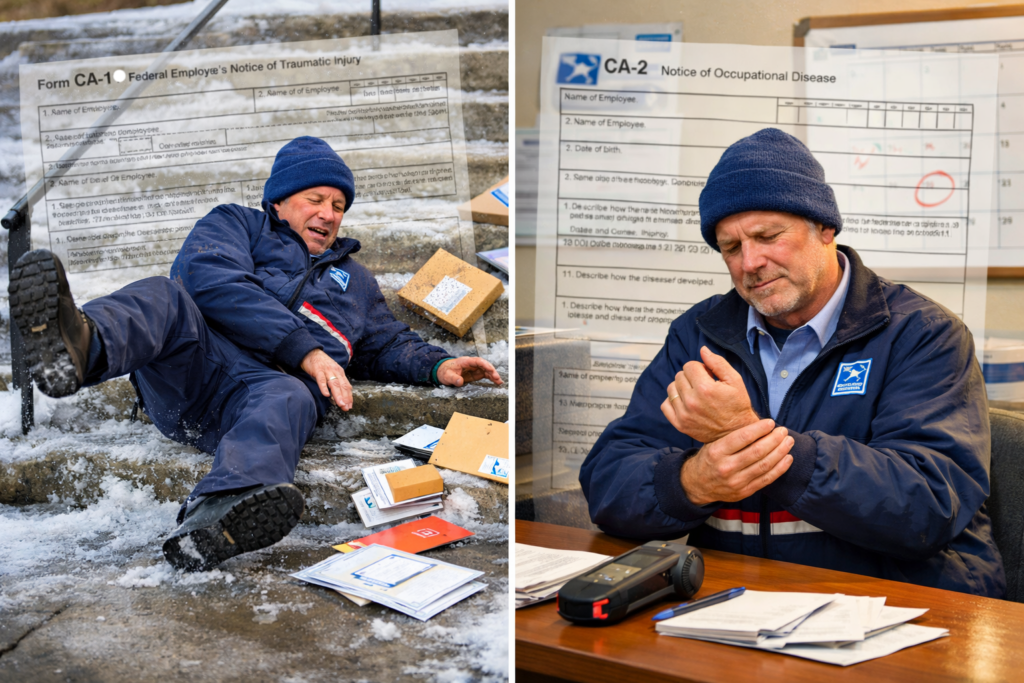
For traumatic injuries reported on Form CA-1, eligible employees may receive Continuation of Pay (COP) for up to 45 calendar days.
- COP provides regular pay
- It is not charged against sick or annual leave
- It applies only to qualifying traumatic injuries
After COP ends, employees may transition to OWCP wage-loss benefits or use leave if benefits are delayed.
Using leave during OWCP claims
Employees sometimes use sick or annual leave while waiting for OWCP approval. In these cases:
- Leave acts as a temporary income bridge
- OWCP benefits, if approved, may later replace lost wages
- Leave used is generally not restored unless specific conditions apply

Leave vs. disability insurance: what’s the difference?
A common misunderstanding is assuming that using leave is the same as being “on disability.” These are not the same.
Leave is not disability income
Sick leave and annual leave:
- Come from time you’ve earned
- Eventually run out
- Do not provide long-term income protection
Disability insurance is separate
Disability insurance (when privately held) is designed to:
- Replace a portion of income when you cannot work
- Pay benefits after a waiting period
- Continue benefits during extended disability, depending on the policy
Leave may cover the waiting period, but it does not replace the role of disability coverage.
How leave usage can affect disability benefit timing
Many disability policies have an elimination period, meaning benefits start only after a certain number of days of disability.
During this time, USPS employees often rely on:
- Sick leave
- Annual leave
- COP or OWCP benefits
Using leave does not usually disqualify you from disability benefits, but it may delay when payments begin. Each policy handles coordination differently, which is why understanding your coverage matters.
Common misconceptions USPS employees have
“If I use sick leave, I don’t need disability coverage”
Sick leave is finite. Once it’s used, there is no automatic replacement unless another benefit applies.
“Annual leave hurts my disability claim”
Using annual leave typically does not harm a disability claim. It simply provides income while other processes are underway.
“Being paid means I’m not considered disabled”
Medical disability is based on your ability to work, not whether you are receiving a paycheck from leave.
Planning ahead during medical uncertainty
USPS employees facing medical challenges often deal with uncertainty about recovery timelines. Understanding how leave works allows you to plan more effectively.
Helpful planning steps include:
- Tracking remaining sick and annual leave balances
- Understanding OWCP eligibility if the injury is work-related
- Reviewing any private disability coverage you may have
- Learning how leave and benefits coordinate
Understanding how sick leave and annual leave fit into disability planning
Sick leave and annual leave are valuable benefits for USPS employees, especially during short-term illness or injury. However, they are not disability benefits and should not be viewed as long-term income protection.
Knowing what each type of leave does—and does not—cover can reduce stress and help you make informed decisions if your ability to work is affected.
If you’re dealing with injury-related income loss as a USPS employee, understanding your disability coverage options can help protect your finances during recovery. Learning how leave, workers’ compensation, and disability income fit together can provide clarity during a difficult time.